
Rising Damp Treatment Manchester: Done Properly, Guaranteed for 10 Years
Trusted Across Greater Manchester Since 2005 | BRE Accredited | We Match Any Like-For-Like Quote
Why Manchester Properties Are Particularly Vulnerable
Much of Greater Manchester’s housing was built before damp proof courses were standard or legally required. Victorian and Edwardian terraces make up a significant proportion of homes in Tameside, Salford, inner Manchester and Stockport. These properties were built with solid brick, no cavity, and lime mortar that’s been softening for a century. Many had a slate DPC installed at the time, which was reasonable for the era. Slate DPCs crack and fail. When they do, rising damp follows.
We’ve also treated a good number of properties where a chemical DPC was injected during the 1970s or 1980s. Sometimes the materials degraded over time. Sometimes the application wasn’t carried out to a sufficient standard. Either way, the damp came back, usually within a decade. Greater Manchester’s rainfall is consistently high, and ground saturation levels here are considerably greater than in drier parts of England. That puts ongoing pressure on any DPC that’s already weakened.
A solid brick terrace in Droylsden, Failsworth, or Gorton without a functioning damp proof course is going to develop rising damp. It’s a question of when, not if. A good many of the calls we receive each month come from homeowners in these older postcodes, looking at the same tide marks returning after decorating and wondering why.
There's Only One Way to Fix Rising Damp
Rising damp gets misdiagnosed often. It gets treated incorrectly almost as often. Both outcomes cost homeowners money they didn’t need to spend, and neither one actually solves the problem. We’ve been carrying out rising damp treatment across Manchester since 2005, and we’ve come across both situations far more times than we’d like.
Here’s what rising damp is, how we identify it, and what proper treatment looks like from start to finish.
What is Rising Damp?
Rising damp occurs when groundwater travels up through the base of a wall by capillary action. Masonry is porous. Without a functioning damp proof course to interrupt that movement, moisture keeps rising, and it’ll carry on doing so regardless of how many times you repaint or redecorate.
The symptoms are usually recognisable: tide marks at low level on internal walls, peeling paint or wallpaper at skirting height, white salt deposits on the plaster surface, and in more established cases a persistent musty odour and plaster beginning to crumble or delaminate. Skirting boards often show deterioration at the base too, sometimes before the walls give any obvious sign at all.
The complication is that some of those signs overlap with condensation damp and penetrating damp. That’s exactly why a proper diagnosis comes before any treatment. Getting it wrong doesn’t just waste money. It means the actual cause is still there and still getting worse.
The Rising Damp Survey: What We Actually Do
Every rising damp treatment we carry out starts with a proper survey. We use calibrated moisture metres to map moisture levels across the affected walls, identifying the height and spread of the damp before we recommend anything. Where there’s reason to suspect moisture behind the plasterwork, we use thermal imaging cameras to investigate without unnecessarily opening up the wall.
We also check for bridging. External ground levels, paths, or render built up against the outside wall above the DPC line is one of the most common and most overlooked causes of apparent DPC failure. In some cases, addressing the bridging is all that’s needed, and if that’s the situation, we’ll tell you. There’s no benefit to us in recommending treatment that isn’t necessary.
The survey is free and carries no obligation. We’ve been surveying properties across Manchester since 2005, and after 600-plus jobs, we know what we’re looking at.
The Rising Damp Treatment Process
Where treatment is required, we carry out damp proof course injection using a BRE-accredited chemical cream system. We drill at precise measured intervals into the mortar bed at the base of the wall and inject the cream, which disperses through the masonry and cures to form a new water-repellent barrier across the full thickness of the wall.
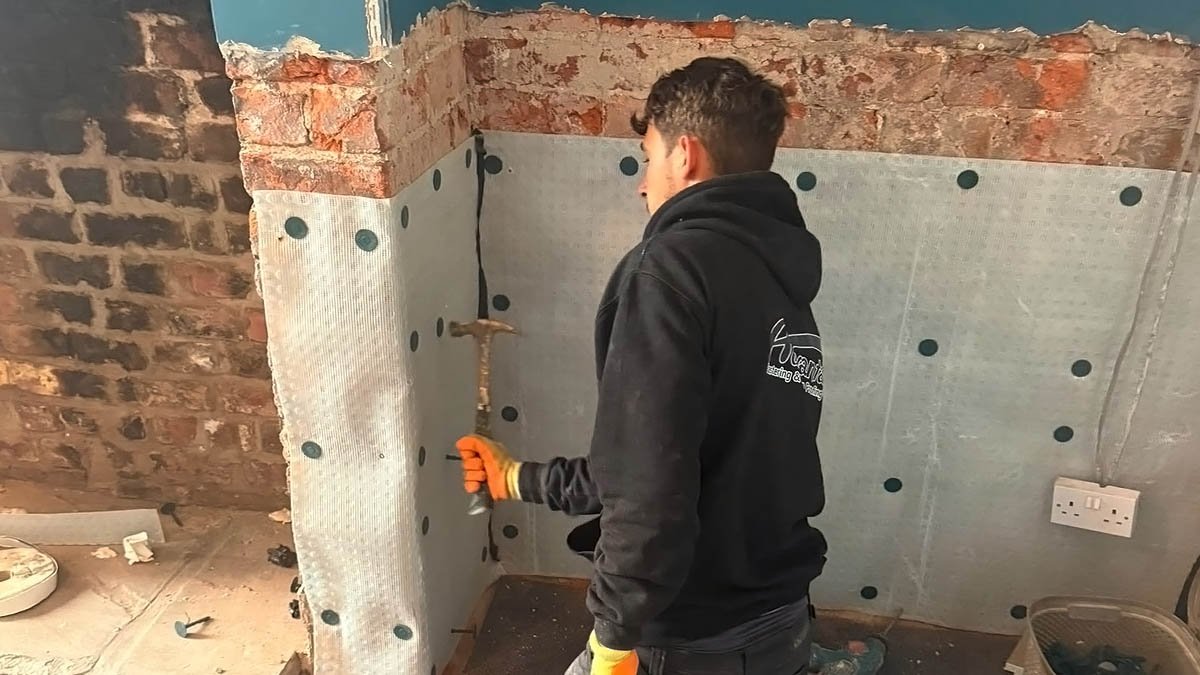
The next step is one that sometimes surprises homeowners: the plaster comes off. It has to. Plaster exposed to rising damp absorbs soluble salts carried up from the ground. Those salts are hygroscopic, meaning they attract moisture from the air even after the DPC has been treated. Applying new plaster over contaminated plaster doesn’t work. The salts come through.
We remove the affected plaster to a height above the salt contamination zone, apply a specialist sand and cement render incorporating a salt-retardant additive, and then replaster to a good finish. All materials are BRE and BSI compliant throughout.
The 10-Year Guarantee
Every rising damp treatment we complete comes with a 10-year guarantee. It’s fully documented and transferable if you sell the property, which matters more than people often realise, particularly when work is being done ahead of a sale, remortgage, or surveyor’s inspection.
The guarantee reflects the quality of the work, not just the paperwork. We don’t apply a new DPC and leave contaminated plaster in place. We don’t skip the salt-retardant render to save time. The 10 years stands because the process is followed correctly.
A Case That Comes Up More Than it Should
We visited a mid-terrace in Hyde a few years back. Rising damp had been treated by another contractor around four years earlier, DPC injection included. The contractor had re-skimmed directly over the existing contaminated plaster without removing it. The damp returned within eighteen months, and by the time we arrived, plaster was failing across a substantial section of the living room wall, salt staining had come through the new skim coat, and the skirting was showing active rot at the base.
Why Choose Advantage?
Need a Rising Damp Treatment?
Your Neighbours Recommend Us
Ready to Solve Your Damp Problem?
Speak to a Damp Specialist